


Our Writer at Large assembles a team of the best minds in the country when it comes to the future of the UK. Here’s what they had to say
THE UK is a mess. That’s the overarching take on the state of the union from the country’s leading constitutional experts.
There will undoubtedly be another Scottish independence referendum, but it won’t happen for years. In the meantime, it could well be Northern Ireland which goes it alone first.
The Herald on Sunday sat down with the heads of the Centre on Constitutional Change (CCC) to find out where Scotland, Northern Ireland, Wales and England stand today.
The CCC is the nation’s leading centre for the study of how the UK is governed and what the constitutional future may hold. It’s based at Edinburgh University.
Talking to The Herald on Sunday were: Dr Karlo Basta, an expert on nationalism, federalism and secession; Dr Davide Vampa, an expert on territorial politics; Professor Ailsa Henderson, an expert on nationalism and devolution who runs the Scottish Election Study; and Dr Fraser McMillan, an expert on Scottish voting behaviour.
All are from Edinburgh University and focused on constitutional issues concerning Scotland. Also from Edinburgh University was Dr Clare Rice, an expert on Northern Ireland constitutional affairs.
Joining the team of academics from Scotland were: Professor Arianna Giovannini, an expert on English devolution from Italy’s University of Urbino; and Dr Anwen Elias from Aberystwyth University, an expert on the constitutional future of Wales. Giovannini and Elias are CCC associate fellows.
Collectively, the seven academics provided a definitive snapshot of the UK’s political health, and how our constitutional future will likely unfold.
SNP
The conversation opened on Scotland. Fraser McMillan began. In terms of its political relevance, independence has gone from the number one issue to “being in hibernation, after the SNP lost the General Election last year – their first electoral defeat since 2010”.
Independence faced a number of hurdles before that, however. There were “legal blocks, and the Brexit vote didn’t translate into long-term increases in Yes support”.
Support is now “basically frozen”. However, McMillan says, “it would be a big mistake for pro-union politicians to think that means the issue is resolved”.
Although independence has “declined in salience in the public imagination and political debate, and John Swinney has tried deliberately to move the focus towards bread-and-butter issues, 45% is a massive chunk of the electorate”.
The SNP is now “playing the long game. It’s a persuasion exercise”. Nevertheless, “people still hold very strong views on either side. No support is more entrenched, but the big divider is age”. More young people support Yes than No.
Demographics mean independence “could very well come back on the agenda”. But “for the moment, it’s in deep freeze”.

Fraser McMillan
Where someone stands on independence “still plays an important role in structuring voting choice”. Although the SNP got their “worst result in 2024 among pro-independence voters, they still held on to two-thirds of those voters, whereas they’re getting a maximum of up to 20% among pro-union voters”.
The 2024 election was unique, however, as voters saw it as “an opportunity to get rid of the Conservatives”. So some people who had previously voted SNP voted for Labour. But they were also “increasingly unhappy with the way the SNP governed”.
McMillan thinks we’ll look back on the 2024 election “as more a disruption than a structural change in voting behaviour, in the way 2014 was”.
His colleague Ailsa Henderson is more “cautious” about terms like “deep freeze”. Although the “salience” of independence has declined, “No voters are very strongly No, and Yes supporters are very strongly Yes”.

Ailsa Henderson
Around two-thirds of Yes voters consider themselves “very strongly” pro-independence. “In terms of how people conceive of themselves, not much has changed.”
However, we’re “starting to see a weaker relationship between constitutional preferences and partisan preferences – not an absent relationship”.
In terms of the decline in SNP support, voters aren’t going to other parties. Rather, “they’re not voting. We’re seeing exit from the system, rather than realignment”. Certainly, there has been no “swing behind Alba”.
Reform
DAVIDE Vampa turns to “the rise of Reform”. Scotland “was long regarded as an exceptional place in Western Europe where you didn’t have the so-called ‘radical right’,”, he notes.
Ironically, the growing “depolarisation” of politics around the constitution “has opened up opportunities for Reform. The political landscape in Scotland was relatively stable over the last 10 years compared to other countries. Now it’s becoming more volatile, more fragmented, which is basically in line with what’s happening in other parts of the UK and Europe”.
Vampa says “depolarisation” can be seen in the way independence has become “less salient in the discussion between parties. The success of Labour confirms this”.
Labour is unionist but was still able to take power by stealing votes from the SNP. Starmer “benefited from the decline in the salience of independence”.
However, as Labour itself begins to decline after taking power, “another party that might benefit from this more fluid situation could be Reform”.

Davide Vampa
Vampa even speculates that some pro-independence voters might become interested in Reform due to the “anti-elite, anti-establishment” vein which runs through the Yes movement.
Karlo Basta notes that prior to taking office, Labour “was promising far-reaching constitutional reform. That was very much signalled as a concession to Scotland”. Now in power, those promises “no longer exist”.
The SNP’s failure to make progress on independence may also have “played a part in dealignment or decoupling” when it came to the link between voters’ constitutional opinions and the ballot they cast.
After Nicola Sturgeon quit, “it was clear the SNP were at a dead end in terms of the pursuit of independence – unless it was going to be some sort of cosplay using elections as a de facto referendum. And, of course, that just fell by the wayside”.

Karlo Basta
Basta adds: “Dealignment might simply be recognition on behalf of some SNP voters, who are in favour of independence, that the SNP is no longer the vehicle.”
Again, Henderson adds a note of caution. “I don’t think people don’t see the SNP as the vehicle. I’d be really cautious about dealignment. I don’t think dealignment has happened yet.”
The 2024 Westminster vote isn’t enough to conclude that “the relationship between constitutional preference and party preference is now weaker”. That vote was about “electing a government, not making a statement about what we want Scotland to be in the future”.
Tories
MOST voters felt it “was all hands to the pump to remove Conservatives from office. We should be careful reading motives in Westminster elections across to constitutional issues and Holyrood elections”.
Westminster and Holyrood elections “run on separate tracks… The kicking [the SNP got] at the polls shouldn’t necessary be read as a sign of a lack of faith in the party’s ability to deliver independence”.
Henderson adds, though, that there’s certainly “increased dissatisfaction” with the SNP “on domestic policy performance and competence”, and also “dissatisfaction with progress towards independence”.
She says: “What we’re seeing is independence support remaining fairly stable, and support for the SNP declining.”
McMillan explains that when it comes to independence support there’s a clear link with how voters view the Westminster government’s competency. “Independence has only once held an extended polling lead over No. That was in 2020/21 during lockdown when people – even pro-union people – thought the Scottish Government was doing a better job than the UK Government.”
It was then that “constitutional persuadables – the group that will decide what happens to Scotland if there’s another referendum – swung more behind independence and the SNP as a result of that perceived gulf”.
After Covid, the “decoupling of Yes support and SNP support was partly due to perceptions that the SNP weren’t doing that great a job”. That became a “perfect storm” as so many voters were also ready to vote Labour to oust the Tories.
However, SNP voters are “returning to the fold” from Labour due to the perception of how the Starmer government is performing.
Right now, “time” rather than the SNP is the vehicle to achieve independence, McMillan believes. “A lot hinges on whether Labour can make the UK feel like a project that’s worth being part of, and restore the optimism that’s been in short supply.”
Economic growth and wage increases “will help make the argument for the pro-union side”. Failure would mean “pro-indy attitudes steadily picking up over time”.
If dissatisfaction led to 60% support for Yes “over a sustained period, that creates the pathway to another referendum, whether by giving the SNP sufficient bargaining clout to extract concessions from Westminster, or if the next Westminster election ends up a messy hung parliament and Labour must cut a deal with the SNP”.
Sustained 60% support would make it “almost impossible for UK parties to resist conceding a referendum”.
McMillan would be “very surprised if there wasn’t another referendum” within about 20 to 25 years.
Ulster
CLARE Rice, a Northern Ireland specialist, turns to whether Scotland needs a legal mechanism that triggers a referendum. The Good Friday Agreement says the secretary of state can call a border poll “if at any time it appears likely… that a majority… would express a wish that Northern Ireland should cease to be part of the United Kingdom”.
Rice notes that the secretary of state has no legal obligation “to publish in advance the criteria for calling a border poll”. The criteria therefore remains at the government’s “discretion”.
Rice cautioned against seeing Ulster providing a solution to the question of another Scottish referendum. “I wouldn’t recommend using Northern Ireland’s current blueprint.”
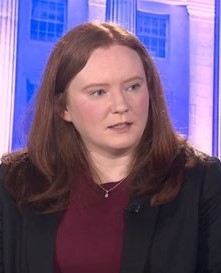
Clare Rice
There is evidently, with Northern Ireland, always risk that constitutional issues spark violence. “We’ve only to look at what happened with Brexit,” Rice says. “It’s so easy for violence to be stoked in Northern Ireland.”
The severity of Ulster’s social problems creates a risk of any border poll causing “the repolarisation of politics. Northern Ireland is frankly falling apart. It’s not in a place for a border poll to be held”. Politics could be “pushed right to the extremes” in ways that haven’t been seen since the Troubles.
Nevertheless, there is, however, “an expectation that there will be a border poll within the medium term at the very least. One academic suggested 2030”. Brexit has speeded up momentum.
Scottish nationalists are “very closely” monitoring what’s happening in the north of Ireland, and vice versa. If a border poll happened it would “inform how quickly” another Scottish referendum was called – and vice versa. “These conversations are bouncing off each other and shaping the way issues are playing out,” Rice adds.
Anwen Elias said that in Wales, an independent commission on the country’s constitutional future noted that there should be a “framework for determining the conditions under which you’d recognise that a part of the UK wants to leave, and the process for doing that”.

Anwen Elias
The lack of any framework means the UK Government can “fudge” the issue. A Labour government was the “best hope” for creating a framework, but in office it has shown little interest.
The UK is unlikely to exist in its current form 20 years from now, Elias thinks. “Wales will still be there, I don’t think we’re going anywhere. But certainly in Northern Ireland we’re likely to see a poll. I’m not sure about Scotland as the process of getting [a referendum] is the stumbling block. The process for Northern Ireland is ambiguous in certain ways, but clearer.”
Karlo Basta said that the best way, therefore, to describe the constitutional future of the UK was as a case of “muddling through”.
Indyref
HENDERSON added that a majority of Scots believed “it should be the right of the Scottish Parliament to call a referendum rather than it being a gift of the UK Government”. Most voters also want more co-operation among the four governments.
Henderson believes that a generation from now “there will still be a UK as it is currently constructed”. Although, the UK electorate overall does expect Northern Ireland to “go first”. Indeed, UK-wide, the electorate would be “fine” with the idea of Northern Ireland leaving the union.
When it comes to Scottish independence, “the arguments for it are more compelling than they were in 2014, but the route towards it less obvious”.
McMillan adds that Brexit, for most Scottish voters, “strengthened the emotional and democratic case for independence but significantly weakened the pragmatic case – so it’s a lot more challenging to argue for”.
How England votes is a major factor in the constitutional question for Scotland, Wales and Northern Ireland – as Brexit proved. More reintegration with Europe would have a “big bearing on how the politics of secession manifest”.
Rice notes that, in the north of Ireland, the prospect of rejoining the EU “is a driving factor for why people support unification”. In Northern Ireland, neither support for the union or unification “goes above 50%”.
Vampa says it’s almost impossible to predict what happens over the long-term constitutionally as British politics has “become very volatile and unstable. In some respects, we’ve seen the Italianisation of British politics”.
Vampa sees global instability as a factor in constitutional politics. Europe might not be able to “find a unified response” to American isolationism and the Russian threat. Security concerns could have an effect on “constitutional views”, says McMillan.
Significantly, among those who don’t support Scottish independence, 75% feel “it’s a nice idea but not worth the risk. So even among pro-union people, the emotional case for independence is very powerful. But whether an independent Scotland is a less risky option versus the rest of the UK is ultimately what will be decisive”.
McMillan thinks the idea of Scottish independence within a generation is unlikely, but if the time frame was 50 years then “there’s a decent chance it’ll happen eventually. It’s not like people aren’t persuadable”.
He adds: “I wouldn’t be able to place a bet on whether Scotland will be independent or not in any time frame beyond 20-25 years”.
However, he does note that if “Reform won a majority in 2029 then indy support would be on steroids”.
If Nigel Farage were prime minister, he’d “say no” to any referendum, which “would help the SNP electorally. It’s the kind of thing which could result in sustained 60% support for independence. A subsequent election might end up putting in place the political opportunities for another vote to happen”.
In other words, a Reform government could trigger prolonged support for independence at 60% and – crucially – a Holyrood Yes majority. “Independence is still a very popular idea that has huge amounts of embedded support in the electorate.”
Populism
McMillan says if he wanted a plan to destroy the union, he’d “make Nigel Farage prime minister”. However, he caveats his comments by adding that even Brexit didn’t take independence to a tipping point. Indeed, leaving the EU “increased the feeling of risk around Scotland venturing out on its own into an uncertain world”.
The Yes movement was so successful in 2014 as it was able to attract “anti-system voters. In Scotland, independence acted as the shock absorber for populist attitudes”.
However, an “educational divide” has opened up politically “worldwide”. University graduates vote very differently to those without degrees. America is a good example, McMillan adds.
Age may remain the decisive factor in Yes-No voting, but increasingly “people with degrees are more likely to support independence”. That’s partly down to the SNP “successfully welding support for Yes to support for progressive values and positions like EU membership”.
Vampa says he doesn’t think Farage becoming PM “would necessarily lead to the fracture of the union. I don’t think it would be a greater shock than Brexit, Boris Johnson and Covid together. We’ve had big shocks over recent years and the situation more or less stayed as it is”.
Rather, he wonders if failure by Starmer’s administration “to deliver anything for Scotland may be a greater risk for the union” as centre-left voters would lose trust in the UK Government.
McMillan adds that Farage as PM, coupled with continued economic and public service decline, would increase the threat to the union. “SNP success will be driven by many of the same underlying socioeconomic factors that might drive Reform support down south. If Labour are unpopular, both those things happen.”
Arianna Giovannini says that when independence “becomes salient in Scotland there’s reverberation in England”. The Tory push for “English votes for English laws” after the referendum is a prime example.

Arianna Giovannini
Henderson adds that “in terms of the union, what defines English attitudes is a prevailing sense of devo anxiety and grievance. The primary target is Scotland. There’s a perception that Scotland has undue influence and access to resources”.
However, a “sense of grievance towards Wales is catching up”. Northern Ireland remains “a black box for the English electorate. If you ask people about Northern Ireland they just don’t know”. Those who voted for Brexit, however, “were perfectly happy to have peace in Northern Ireland disrupted and for Scotland to leave the union if it meant they got what they wanted. They were willing to see certain aspects of this ‘precious’ union sacrificed”.
England
BROADLY, the English electorate “as a whole is happy” to see Northern Ireland leave, “less supportive of independence for Scotland, and least supportive of independence for Wales. There’s a sense of ‘if Wales is with us, it’s still the union’.”.
However, English voters aren’t happy with the status quo in terms of the constitutional settlement for England. Yet, regional devolution – where England would be “carved into Scotland-sized chunks” in order to create a federal UK – remains more unpopular in England than the status quo.
“Treating England as a single political unit is always the most popular option,” Henderson adds. “The consequences of not doing that are figures just completely in the toilet.”
However, a federal system couldn’t work without England being carved into chunks the size of the other home nations. Without that, large England would outweigh smaller Scotland, Wales and Northern Ireland every time.
“The least destabilising solution is also the least popular,” Henderson says. That means, however, that we remain with “devolution to only three of the four parts of the UK”.
This muddle “is completely consistent with the political culture of Britain. We identify ad hoc solutions in the moment. That’s been a feature of British politics since the 1830s – this desire to only make radical change to see off something more radical. The serial ad hockery that’s a cornerstone of UK political culture is the obstacle”. Henderson believes this exists as “we focus on the past, not the future”.
Giovannini says the “perception that England is the core of the union, and synonymous with Westminster, complicates matters”. That created the sense that there was no need for English devolution. Yet now “there is a need to create a system of devolution in England” due to “huge socioeconomic divides in England and the very different identities within England”.
Attempts to create devolved systems in England which map on to regional identity can be difficult. There’s devolution in the area defined as the west of England, but Bath and Bristol don’t have the same sense of strong identity as somewhere like Cornwall.
Giovannini adds that, constitutionally, she’s “not a supporter of this muddling through, but probably muddling through is the easiest way”. A UK Government would find it hard to win support for “radical change”.
Elias says the UK Government simply “isn’t interested in having a conversation” with Wales about its constitutional future. There’s a sense of “who cares what Wales thinks”. She notes that support for Welsh independence isn’t confined to Plaid Cymru but extends into Labour’s “grass roots”. There’s also “little sign of interest in making devolution work more efficiently”.
While that continues, “it’s difficult to see how we cannot but muddle through”. However, policy problems around health or education in Wales, Scotland and Northern Ireland “are very closely intertwined” with the constitution as “there are limits to what we can do because of the nature of the devolution settlement”. Policy challenges are also “constitutional challenges”.
The SNP is “shielded”, however, from policy failures due to the constitution, Henderson explains. It can “evade the cost of governing” by “blaming the UK Government”. As long as the SNP seems “competent” in comparison to the UK Government it’s protected.
Labour
SIMILARLY, the SNP can claim to be better at “standing up for Scotland” than Labour. “It has two shields… A competence advantage over the UK Government, and a trust advantage over Labour”. The SNP “shed” its competence advantage in the face of Starmer’s election campaign. However, Starmer’s performance in power has seen the gains Labour made disappear.
The SNP does retain its trust advantage. Tactical voters who left the SNP for Labour “are coming home”. That’s unsurprising. Even two in five Labour supporters think the London government is “doing a bad job”.
In Wales, independence support is driven by the same sense of “grievance” over the union as in Scotland, says Elias – the notion that “being part of the UK doesn’t serve us well, that we’ve different needs”. Nevertheless, support for Welsh independence only stands at 25%, around the same as support for abolishing devolution.
McMillan believes the creation of British identity – as an addition to English, Scots, Welsh or Northern Irish identity – worked best in England as “England was the central unit and had the vast majority of the population”. These “sub-identities for all parts of Britain make it more challenging to come to any lasting territorial settlement”.
Other nations don’t have such layered identity. Someone from Madrid, for example, isn’t Spanish and Castilian, they’re just Spanish.
McMillan adds that the best way to secure the union “in perpetuity” would be to “call the SNP’s bluff and hold another referendum”. Support isn’t high enough to win, and if the Yes side lost again, that would spell lasting defeat as in Quebec. “Lose twice and it’s game over,” he says.
“But the pro-union elite, by stonewalling the question, created the risk of sleepwalking into a situation where independence has consistently two-thirds support in the future.”
The greatest risk to the UK is what McMillan calls “punctuated equilibrium” – that matters stay the same “for a long time, until they don’t and they then change very rapidly and you’re in a new status quo. That could easily happen”.
When it comes to other constitutional changes, 56% support “a closer relationship” with Europe. Interestingly, support for reform of the House of Lords runs strongest among Reform voters.
One much under-discussed issue is devolving power within Scotland so it spreads away from Edinburgh and the central belt. Holyrood’s centralisation of power must be addressed, says Vampa.
For Elias, the big question is: “does the union function optimally?” The answer is: “No, absolutely not.” There’s “unfairness” in the current system due to the “lack of opportunity to have conversations as equals about how we can do things better. There’s unfairness about how we work democratically as a union of nations”.
Rice says there’s “a dearth of awareness and understanding in each part of the UK about each of the other parts of the UK”. Culturally and politically we don’t know enough about each other. That undermines the union. “What separates us extends much further than just territorial borders – it’s borders of the mind as well,” she says.
“Each part of the UK has a very different relationship to what the UK is and what its own place within the UK is.”
As the conversation winds down, Basta closes by saying there’s been a “laissez-faire” approach to the union, a case of “devolve and forget”.
“It’s like we really don’t need to put so much effort in because it’s too much trouble,” he adds.
In the end, then, it might not be the campaigning of the SNP, Plaid Cymru or Sinn Fein which kills the union. It could, as the group speculates, be something as very British as “benign neglect”.


Share