


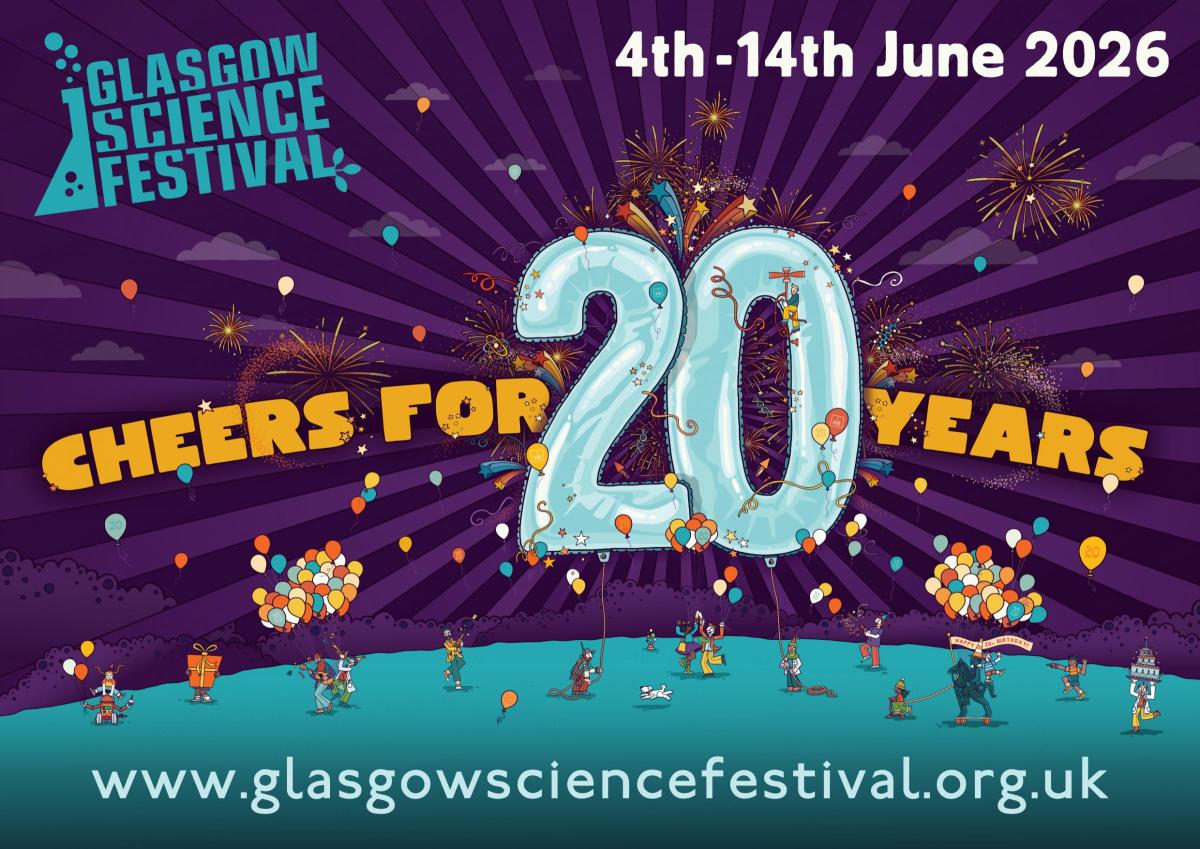

The programme for the 20th annual Glasgow Science Festival has been released, with a packed programme of events set to take over the city from Thursday 4th to Sunday 14th of June.
Primarily funded by the University of Glasgow and the Scottish Government, and built around the theme ‘Cheers to 20 Years’, the event will take place across a range of landmark venues including the Botanic Gardens, the Riverside Museum, and the Kelvingrove Art Gallery. Libraries across Glasgow will also host a series of activities, as will both the Govan and Gorbals local fairs.
In total more than 175 sessions will be delivered by scientists, staff and students from universities across the city and beyond, with further contributions from partner organisations such as the NHS and RSPB.
The University of Glasgow’s Mazumdar-Shaw Advanced Research Centre (SRC) will also play a key role, hosting events through the festival’s run.
Since launched the first Festival in 2007, organisers estimate that almost 900,000 visitors have taken part in events, with more than 200,000 school pupils participating in broader outreach activities including the annual Creating Engineers competition.

As part of efforts to expand its reach into the digital world, the 2026 Festival will also continue the online ‘Science of the Sofa’ events introduced during the Covid pandemic.
Having begun with 88 events and fewer than twenty partners, the Glasgow Science Festival now boasts nearly 200 individual sessions and more than 130 partners. More than 1,000 volunteers and staff help to bring the programme to life each year, and the overall event is a three-time winner of Best Scottish Festival at the Scottish Hospitality Awards.
Highlights of this year’s Festival include Dog with Jobs, which explores the science behind the success of working dogs, Songs from the Cosmos, in which a scientist and musician discuss harnessing cosmic rays to create a “unique audiovisual performance”, and the Dear Green Music Scene, a hydrogen and solar powered music festival and ceilidh in St Mungo’s Square.
Popular Glasgow bar The Alchemist will also host a Molecular Masterclass in which professional mixologists demonstrate the science behind cocktail-making.
Glasgow Science Festival was founded by Dr Deborah McNeill of the University of Glasgow, who has also served as director for the past two decades. She told The Herald that the event was inspired by the success of similar festivals in Edinburgh and Orkney at a time when public engagement around science was still “in its infancy.”

Initially developed as a University of Glasgow event, the Festival soon expanded thanks to the contributions of other institutions across the city, the country, and even the world. Nonetheless, accessibility – both geographical and financial – remains a key concern, and almost all events are provided to the public free of charge.
The Festival does not “buy in high-brow speakers or big shows”, focusing instead on providing a platform through which Scotland’s research community can engage with, and be engaged by, local audiences.
“So we have these really accessible events,” Dr McNeill explains, “where we just bring everybody together and give people a chance to engage chat and play.”
She also notes that, in the past, a key focus of the Festival was taking events into schools, but that over the past twenty years a lot of the support for STEM in those spaces has “grown up”, increasing the offers available to teachers and their pupils.
“On the back of that we pivoted a little bit on how we do some stuff so that more resource went to our community focused events. We still run a lot of school-focused activity but we just do it in different ways. So instead of bringing schools onto campus for small workshops or labs we have what we call our Festival Activity Days.
“So we take over the Botanic Gardens, the Riverside Museum, places like Kelvingrove. They're just a they're just a lovely format.
“Every day there'll be a program of 10 to 12 different stages of activities and every activity is led by a research group or one of our partner organisations that we work with.
“Schools can come in, the public can come in, and they can just work their way around all of these different groups of people that are doing activities related to their actual research. It's a really lovely way for schools and the public to get a sense of just the sheer breadth of what actually happens in Glasgow.”

Dr McNeill added: “It’s remarkable to reflect on how far we’ve come since the start of the Festival, reaching more than a million visitors at in-person and online events. Everything we’ve achieved so far is thanks to the enthusiasm and commitment of the city’s science community and our wider partner network.
“We’ve now been running long enough that children who were inspired by visiting Festival events in previous years are starting science careers of their own today. I recently met a woman who is studying neuroscience at the University of Glasgow who had been at the Festival in 2008, and we managed to find a picture of her wearing a lab coat at event back then.
“It’s wonderful to think that we’ve made a real impact on people’s lives and played a part in creating the next generation of world-changers.”
For more information on the Festival, its 20th anniversary, and the complete programme, visit the Festival website.


Share